- To build my business website the right way, start by defining its single most important goal before choosing anyone or anything.
- Decide your pages, features, and a realistic budget before you contact a developer, so quotes are comparable.
- Register your own domain and hosting first, so you always own your site, no matter who builds it.
- A one-page brief turns vague quotes into sharp, comparable ones and reveals which candidate understands your business.
- For most businesses, a senior independent developer or small studio is the right build partner, not the cheapest freelancer.
To build my business website when I am starting from zero, the first move is not choosing a platform or a person. It is deciding what the website must actually achieve. Once that single goal is clear, every later choice, from budget to who you hire, becomes far easier and far cheaper to get right.
Almost every “how to build a website” guide online is really an ad for a page builder, pushing you to do it yourself with their tool. This is not that. It is for the business owner who has already decided they want a professional to build it, and just needs the right order to do things in.
Across 80+ builds over eight years, the business website projects that went smoothly all started the same way: with a clear plan before a single dollar was spent. Here is that plan, in seven steps.
Step 1: Define What Your Business Website Is For
Before you build a business website, write one sentence describing its single most important job. Not “have a website,” but something specific: book consultations, sell products, generate quote requests, or prove you are legitimate to people who found you elsewhere. That one goal shapes every decision that follows. As Shopify’s business website guide notes, even a simple site legitimizes your operation and helps establish credibility.

This step matters more than it looks, because a website is not optional anymore. According to DreamHost’s 2026 Local Business Trust Index, businesses with a website are perceived as 41% more trustworthy than those without, making a site the strongest credibility signal outside of online reviews. In other words, your website is often the first place a potential customer decides whether to trust you.
So get specific about that first impression. Ask yourself what one action you most want a visitor to take. A plumber wants a call. A consultant wants a booked discovery session. A boutique wants a sale.
When you know the single action, you can tell any developer exactly what success looks like. That is the difference between a site that decorates and a site that earns. Speed is part of that: Google’s Core Web Vitals guidance is the performance baseline any developer should build to.
Pro tip: Finish this sentence before anything else: “This website is successful if a visitor ______.” If you cannot fill the blank, you are not ready to hire yet, and that is useful to know early.
With the goal fixed, you can work out what the site actually needs to contain.
Step 2: Decide What Pages and Features You Need
List the pages and features your business website needs to hit its goal, and separate the must-haves from the nice-to-haves. Most business websites need only a handful of pages done well, so resist the urge to plan a sprawling site you will never finish filling with content.
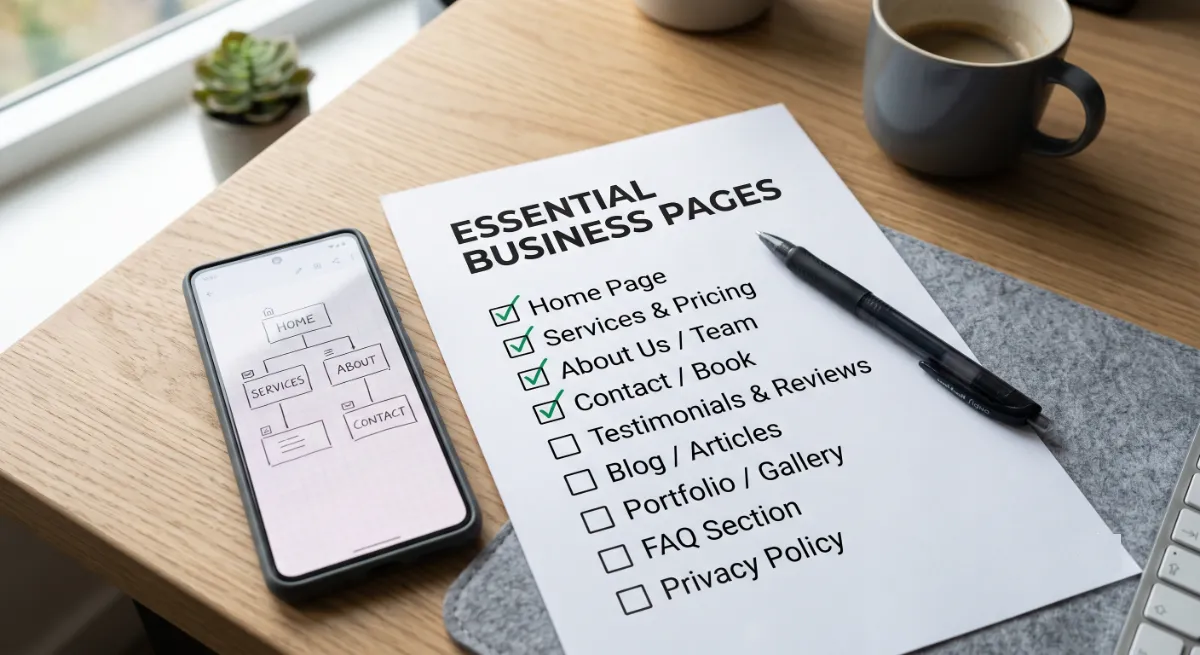
For most businesses, the essential pages are simple: a home page that says what you do and who you help, a services or products page, an about page that builds trust, and a clear contact path. That core covers the majority of small business needs. You can always add more later, once the site is live and earning.
On a business website, features are where budgets quietly balloon. A booking system, an online store, a member login, or a multi-language setup each adds real cost and complexity. Therefore, be honest about which ones your goal genuinely requires now, versus which ones simply sound good. A simple brochure site and a full online store are fundamentally different projects with very different price tags.
Once you know what you are building, you can put a realistic number on it.
Step 3: Set a Realistic Business Website Budget
Set a realistic business website budget before you talk to anyone, because a clear budget range gets you sharper, more honest quotes. For most business websites in 2026, plan for $1,000 to $3,000 for a basic professional site and $3,000 to $8,000 for a genuinely custom one, plus ongoing hosting and maintenance.
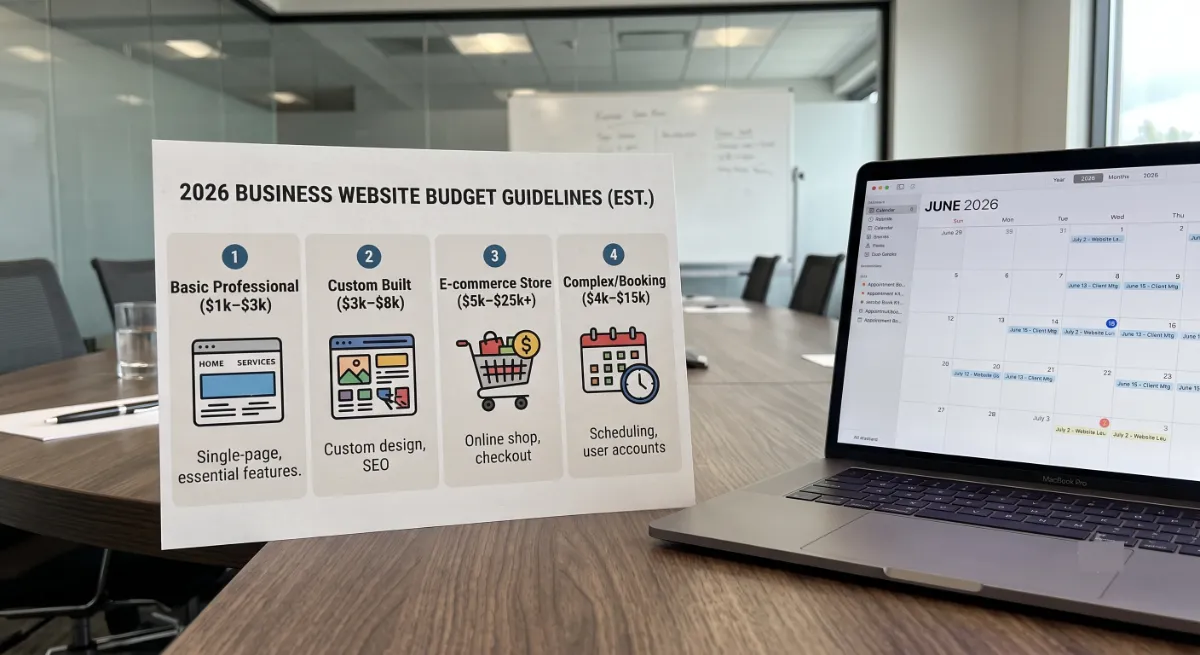
Here are the realistic 2026 ranges for the most common business-website projects:
- Basic professional site: $1,000–$3,000. A handful of well-built pages and a contact form.
- Custom business website: $3,000–$8,000. Unique design and brand-specific features.
- Online store: $5,000–$25,000+. Products, payments, and shipping logic.
- Booking or membership site: $4,000–$15,000. Custom functionality and integrations.
Remember that the build is not the only cost. You will also pay, usually to third parties, for a domain name (around $10–$15 a year), hosting, and any premium plugins. Consequently, a quote that leaves these out is not cheaper. It is just incomplete, and the gap lands on you later.
Pro tip: Share a budget range, not a single number, and ask what each candidate would prioritise within it. A good developer will tell you honestly what fits and what does not, instead of quietly stretching the scope.
Want to see real numbers before you plan?
Our pricing is published up front, line by line, with no discovery call required. View transparent pricing.
With a budget in hand, the biggest decision is who actually builds the thing.
Step 4: Choose Who Builds Your Business Website
Choose between a freelancer, a small studio, or an agency based on your project’s size and how much accountability you need. For most businesses starting out, the right partner to build a business website is a senior independent developer or a small studio, giving you experienced work without the overhead of a large agency.

The business website tradeoffs are straightforward. A budget freelancer is cheapest but carries the most risk, since one person can vanish or cut corners under pressure. A large agency brings a full team and process, but you pay for management layers a small project does not need. A small studio or senior independent sits in the middle: experienced hands, direct communication, and a real person to call when something breaks.
This decision deserves its own careful look, because it is where the most money is won or lost. We cover the full comparison in our guide on who to hire to build a custom website, and if you run a small business specifically, our breakdown of choosing a developer for a small business goes deeper on budget and fit. Both build directly on the steps here.
Whoever you choose, one step protects you more than any other, and people skip it constantly.
Step 5: Own Your Domain and Hosting
Register your domain name and hosting account in your own name before work begins, then add your developer as a user. This single step guarantees you own your business website no matter who builds it. Skipping it is the most common way business owners lose control of their own site.
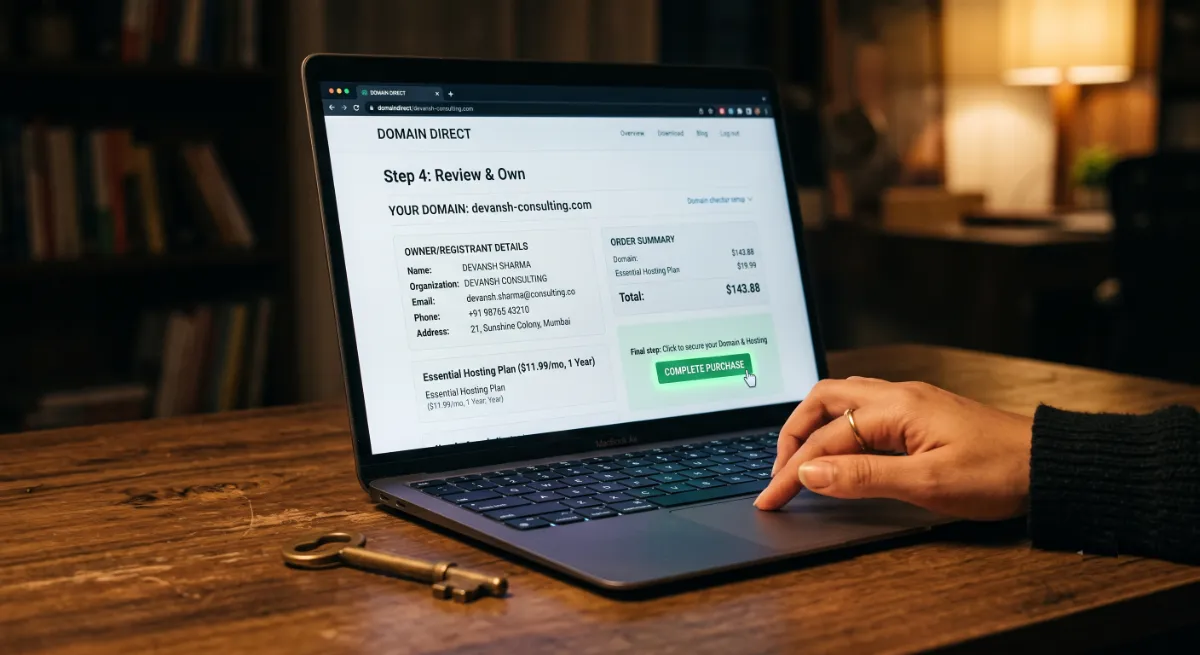
The domain is your address, like yourbusiness.com, and hosting is the space where your site lives. Both should be bought with your own email and payment details, not your developer’s. It costs the same either way, and it keeps the keys to your business in your hands. A good developer will happily be added as a collaborator rather than the owner.
With ownership secured, you are ready to turn your plan into something a developer can quote against.
Step 6: Write a One-Page Brief
Write a one-page business website brief that captures your goal, your pages, your must-have features, your budget range, and a few examples of sites you like. This single document turns vague, hard-to-compare quotes into sharp ones, because developers price uncertainty, and a clear brief removes it.
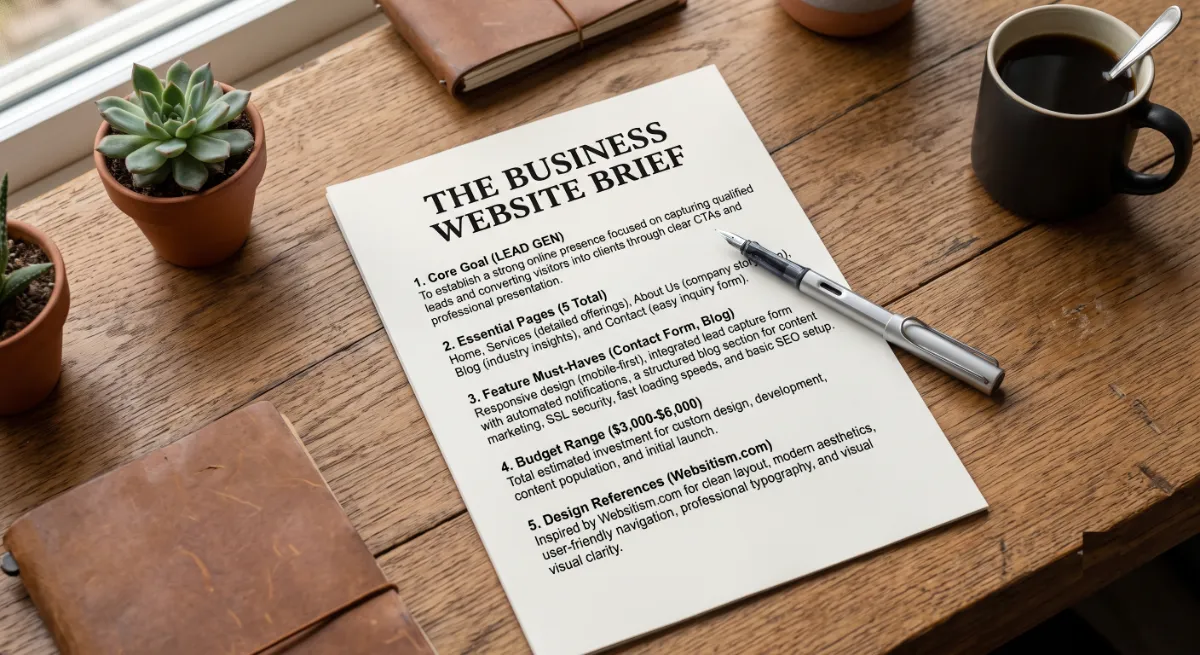
Keep your business website brief genuinely to one page. Include the single goal from step one, the must-have pages and features from step two, your budget range from step three, your timeline, and two or three links to websites whose style you admire. That last detail saves everyone hours of guessing. Clear requirements are not bureaucracy. They are the difference between a project that finishes on budget and one that drifts.
The payoff is comparability. When three candidates quote against the exact same one-page brief, their numbers finally mean something. Furthermore, their questions reveal who is paying attention, which sets up the final step perfectly.
Pro tip: Add one line to your brief: “Tell me what you would remove to keep this on budget.” The answers instantly separate order-takers from real advisors.
Brief in hand, you are ready to actually choose someone.
Step 7: Shortlist and Vet Candidates
Send your one-page business website brief to three candidates, then compare their questions as closely as their quotes. The developer who asks the sharpest questions about your business, not just your page count, is usually the one who will build the best site, because they are already thinking about your problem.

For each candidate, check three things before you commit. First, ask for three live websites they personally built, then open them and click around. Second, get a fixed price against your written brief, not a vague hourly estimate. Third, confirm what happens after launch: who fixes problems, and whether you keep all files and access if you leave. These three checks filter out most poor fits quickly.
Watch for the obvious warning signs too. A candidate who dodges references, has no live sites to show, wants full payment upfront, or says yes to everything without asking questions is telling you something. Trust that signal. A short vetting conversation now prevents an expensive rebuild later.
Feeling stuck before you even begin?
Tell us what your business does and what you want the site to achieve. We will help you shape the plan, even if you are months away from building. Start the conversation.
Frequently Asked Questions
I need someone to build my business website, where do I start?
Start by writing one sentence describing what the website must achieve, then decide your pages, features, and budget before contacting anyone. Register your own domain and hosting, write a one-page brief, and send it to three candidates. Planning first makes hiring faster, cheaper, and far less stressful.
How much does it cost to build a business website in 2026?
A basic professional business website typically costs $1,000 to $3,000 in 2026, while a custom one runs $3,000 to $8,000. Online stores start around $5,000. Add ongoing costs for a domain, hosting, and maintenance, which are usually paid separately to third parties.
Should I build my business website myself or hire someone?
Build it yourself only if it is simple and your budget is very tight. If the website drives real revenue or needs to look professional and load fast, hiring a senior independent developer or small studio usually pays for itself. Your time has value too.
What do I need to prepare before hiring a web developer?
Prepare a one-page brief with your main goal, must-have pages, required features, budget range, timeline, and two or three example sites you like. Gather your content, such as text and logos, and register your own domain and hosting. This preparation gets you sharper, more comparable quotes.
How long does it take to build a business website?
A straightforward business website usually takes two to four weeks, while custom designs or online stores can run six to ten weeks. Timelines slip most often because content is not ready, not because building is slow, so prepare your text and images before the project starts.
Do I own my website if someone else builds it?
You own it only if you registered the domain and hosting in your own name and your contract transfers the code to you on final payment. Never let a developer hold these accounts. Owning your domain and hosting from day one keeps control of your site with you.
Who should I hire to build my business website?
For most businesses, a senior independent developer or a small studio offers the best balance of quality, cost, and accountability. Ask for live work, a fixed quote, and post-launch support. Our custom WordPress development service is built exactly for that need.
Conclusion
When you need someone to build your business website, the smartest first step is planning, not shopping. A business website rewards preparation more than speed. Define one clear goal, decide your pages and budget, own your domain and hosting, and write a one-page brief before you contact anyone. Then send that brief to three candidates and compare their questions as closely as their prices. Do that, and a stressful, jargon-filled decision becomes a calm, confident one. You are more ready than you think.
Ready to take the first real step?
Bring us your goal and your questions. We will help you plan the build and give you an honest, fixed quote, with no pressure. Get started today.
A one-page checklist covering all seven steps, the essential pages, the budget ranges, and the exact questions to ask a developer, so you can go from idea to shortlist without missing anything.
Get it free →This article was last reviewed and updated in {{UPDATED}} to reflect current 2026 website planning and hiring best practices.