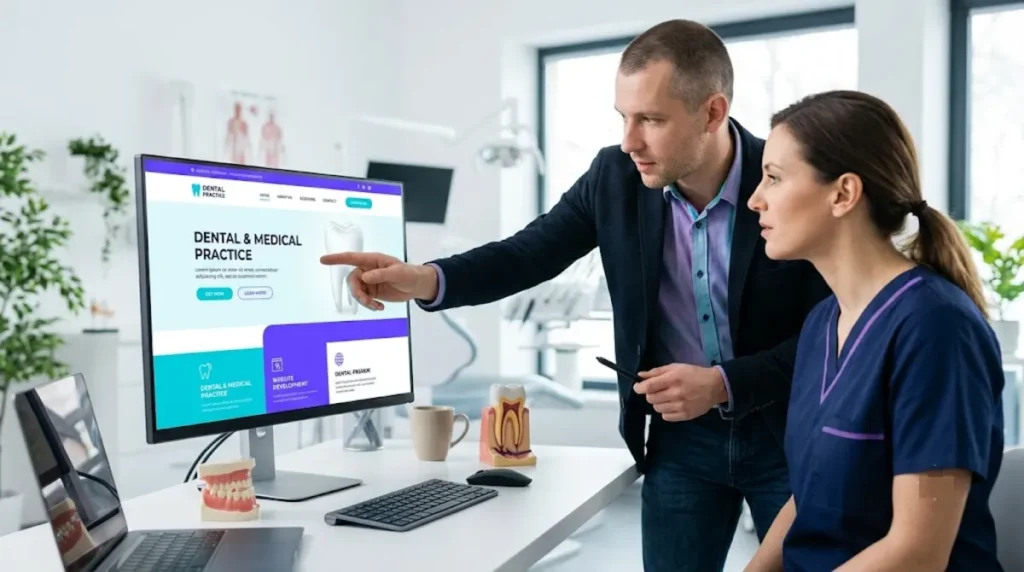
- The best developer for a dental or medical practice website is a healthcare specialist who understands HIPAA, patient trust, secure booking, and local SEO, not a generalist who treats it like any other site.
- The biggest hidden risk is the HIPAA trap: a form, booking tool, or analytics setup that mishandles patient data can create real legal liability with penalties per violation.
- A real practice website is a patient-acquisition engine: trust signals, provider bios, per-service pages, easy secure booking, and local search.
- A custom medical or dental practice website typically costs $3,000 to $15,000 in 2026, depending on size, features, and integrations.
- Vet for healthcare experience, HIPAA awareness, booking and local-SEO thinking, accessibility, and clear ownership terms.
The best web developer for a dental or medical practice website is a healthcare specialist: someone who understands HIPAA and patient-data handling, builds trust and secure online booking, and knows local SEO, not a generalist who treats a practice site like any other business website. The healthcare-specific requirements are exactly where the wrong hire creates real risk.
Here is what makes this hire different: a dental or medical practice website handles sensitive patient information, must comply with federal privacy law, and has seconds to convince a cautious patient to book with you rather than a competitor. Get the developer wrong and you risk not just a weak site but a compliance problem. This guide explains why a healthcare practice site needs a specialist, what it actually requires, who should build it, and what it costs in 2026.
Why a Medical Practice Website Is Not a Normal Site
A medical practice website is not a normal site because it collects sensitive patient data under federal privacy law, must earn the trust of a cautious, comparison-shopping patient in seconds, and depends on booking and local search, so it needs a developer who understands healthcare-specific requirements. The same is true for dental practices.
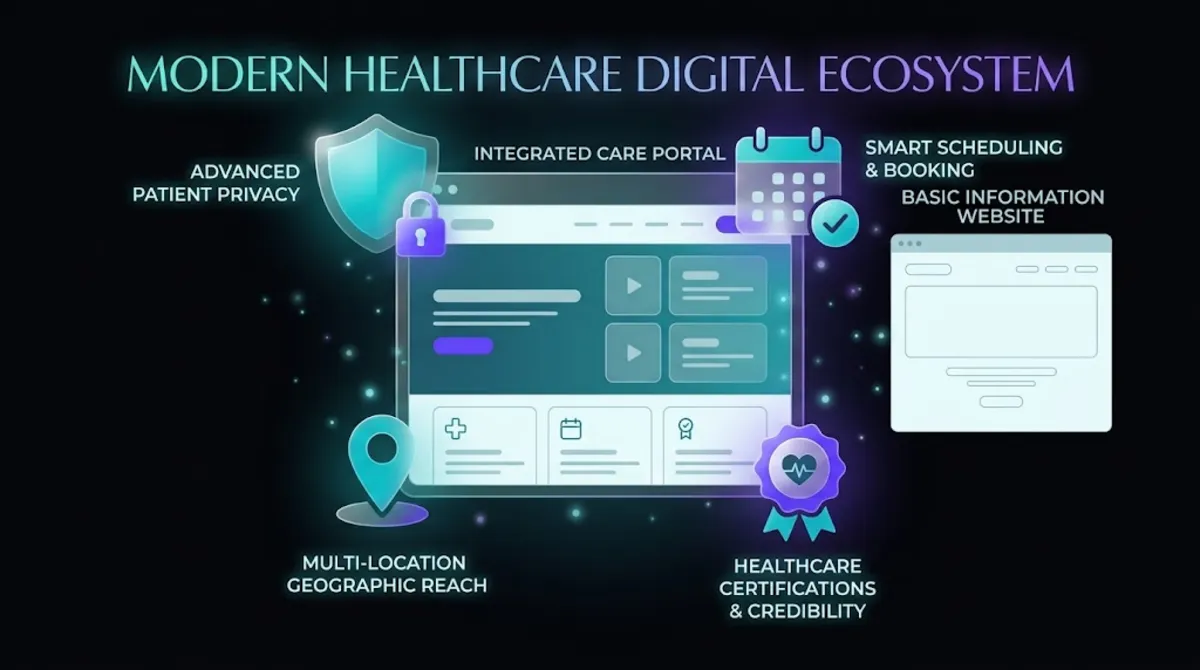
The healthcare context changes how the site must be built. Several factors make it genuinely different:
- Patients are cautious and compare. People choosing a doctor or dentist are often anxious and weigh several practices, and a large majority research online before booking, so trust has to be established fast.
- The value per patient is high. A new patient can be worth thousands over their relationship with the practice, so every visitor lost to a weak site is a meaningful revenue event.
- Federal privacy law applies. The moment a site collects identifiable patient information, HIPAA obligations can attach, which most generalist developers have never dealt with.
- Booking is the conversion. Patients increasingly expect to book online rather than call, and a majority prefer it.
Because of all this, many practices build on a flexible, well-supported platform, commonly WordPress, so the site can be tailored to these healthcare-specific needs rather than forced into a rigid template. The point is that a practice site is a specialist build, and the most specialist part, the one a generalist most often gets wrong, is privacy compliance. If your practice needs the whole build handled end to end, our custom WordPress development service is built for exactly this.
Pro tip: Ask any candidate whether they have built for healthcare specifically. “We build for every industry” is not the same as understanding HIPAA, and on a patient-facing site that gap matters a great deal.
The HIPAA Trap: The Mistake a Generalist Makes
The biggest hidden risk in a dental or medical practice website is the HIPAA trap: forms, booking tools, and analytics that touch identifiable patient data can create legal liability if handled without proper safeguards, and a generalist developer usually has no idea. This is the clearest reason to hire a healthcare specialist.
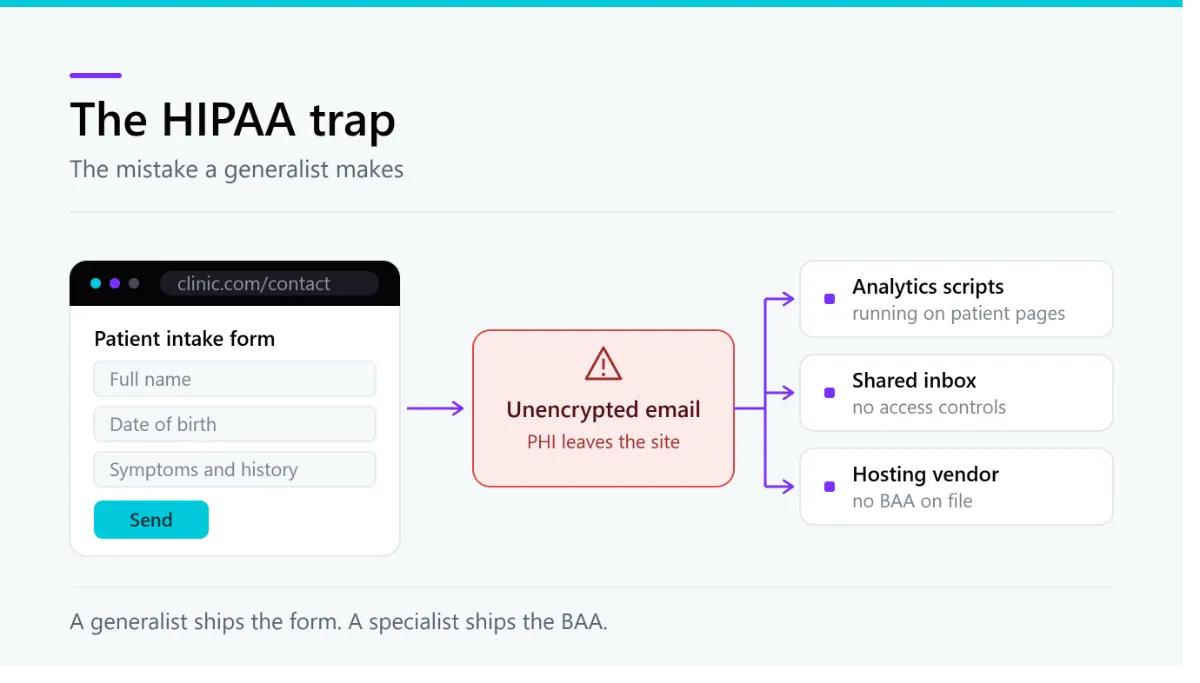
This is where the wrong hire becomes genuinely dangerous, not just disappointing. Under U.S. federal law, any vendor or tool that handles identifiable patient information on a practice’s behalf can become a business associate requiring a formal agreement, and the practical consequences are everywhere on the site:
- Standard contact and intake forms. A normal form that emails patient details to an ordinary inbox can mishandle protected information, so healthcare forms need secure, compliant handling.
- Booking tools and chat widgets. Any tool that collects health information must route it through a compliant platform under a proper agreement.
- Analytics and tracking. Ordinary tracking can capture identifiers such as IP addresses, which can count as protected data in a healthcare context, so analytics must be configured carefully.
- Hosting and vendors. Any service that touches patient data may need to be covered by an agreement, which a generalist rarely considers.
A generalist web developer, however skilled, usually has no idea these obligations exist, and their oversight becomes the practice’s liability, because it is the practice, not the developer, that answers for a breach.
Penalties for mishandling patient data can run from hundreds to tens of thousands of dollars per violation, so this is not a small risk. A healthcare specialist builds these safeguards in from day one rather than bolting them on after a problem appears. This is the heart of why a practice site is a specialist job, and it leads to what the site actually needs.
Want a site built HIPAA-aware from day one?
We build healthcare sites with privacy, security, and trust designed in from the start. See our healthcare web development.
What a Medical Practice Website Actually Needs
A medical or dental practice website needs trust signals, provider bios, a dedicated page per service or treatment, secure and easy online booking, local SEO, accessibility, and fast mobile performance, all working together to turn a cautious visitor into a booked patient. Each element does a specific job.
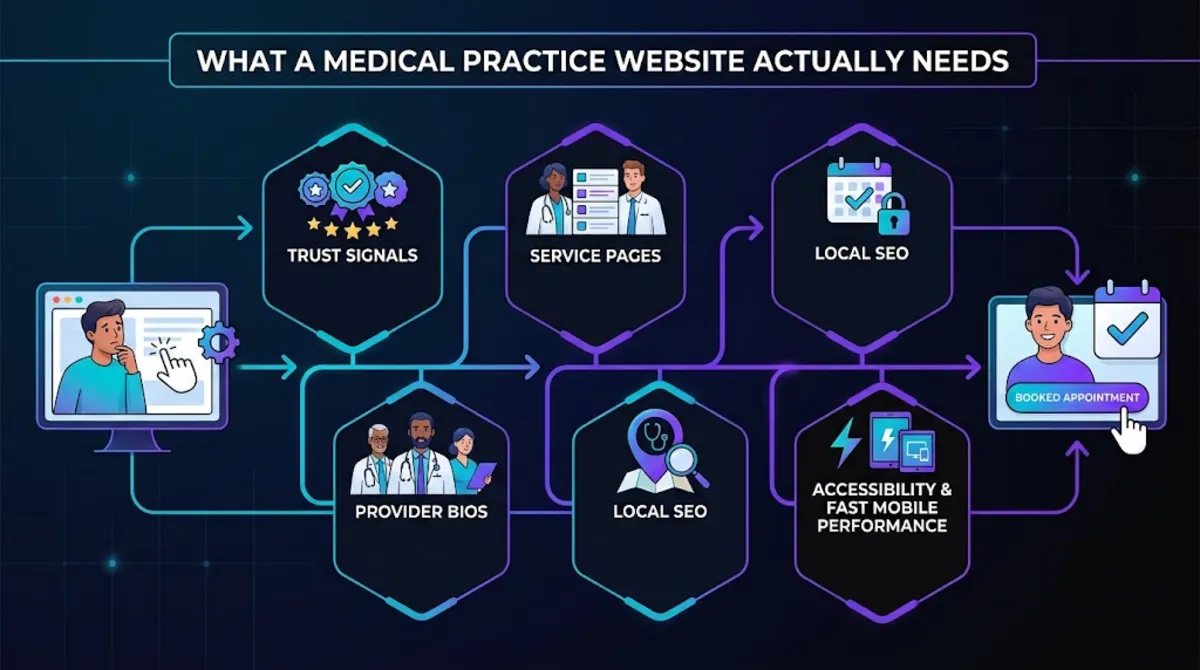
A real practice site is a patient-acquisition engine, not a brochure, and that means specific ingredients:
- Trust architecture. Provider bios with real credentials and photos, an authentic sense of the practice, and genuine reviews, since patients are trusting you with their health.
- A page per service or treatment. One page per procedure you offer, not a single combined page, because granular pages rank better locally and answer the exact question a patient is asking.
- Secure, easy booking. Online scheduling and click-to-call, visible on mobile, handled through a compliant pipeline, since most patients now expect to book online.
- Local SEO and accessibility. Patients search locally for care, and healthcare sites are treated as public accommodations, so accessibility is both a duty and a real legal exposure.
The through-line is that every element serves trust and conversion, because a cautious patient decides quickly whether to book with you.
This is also why speed and mobile matter so much: most patients search on their phones, often urgently, and a slow or clumsy site loses them before they read a word. Accessibility deserves particular care, since healthcare sites are frequent targets, and our accessibility and WCAG compliance service covers it properly. With the requirements clear, the question becomes who can actually deliver all of this.
Pro tip: Insist on one page per service or treatment rather than a single “services” page. It is one of the highest-impact choices for both local ranking and patient conversion.
Who Should Build It: Generalist, Specialist, or Studio
To build a dental or medical practice website you can hire a generalist web developer, a healthcare-specialist agency, or a capable studio with genuine healthcare experience, and the safest choice is someone who truly understands HIPAA and patient conversion, not simply the cheapest or nearest option. The compliance and trust stakes make specialisation matter.
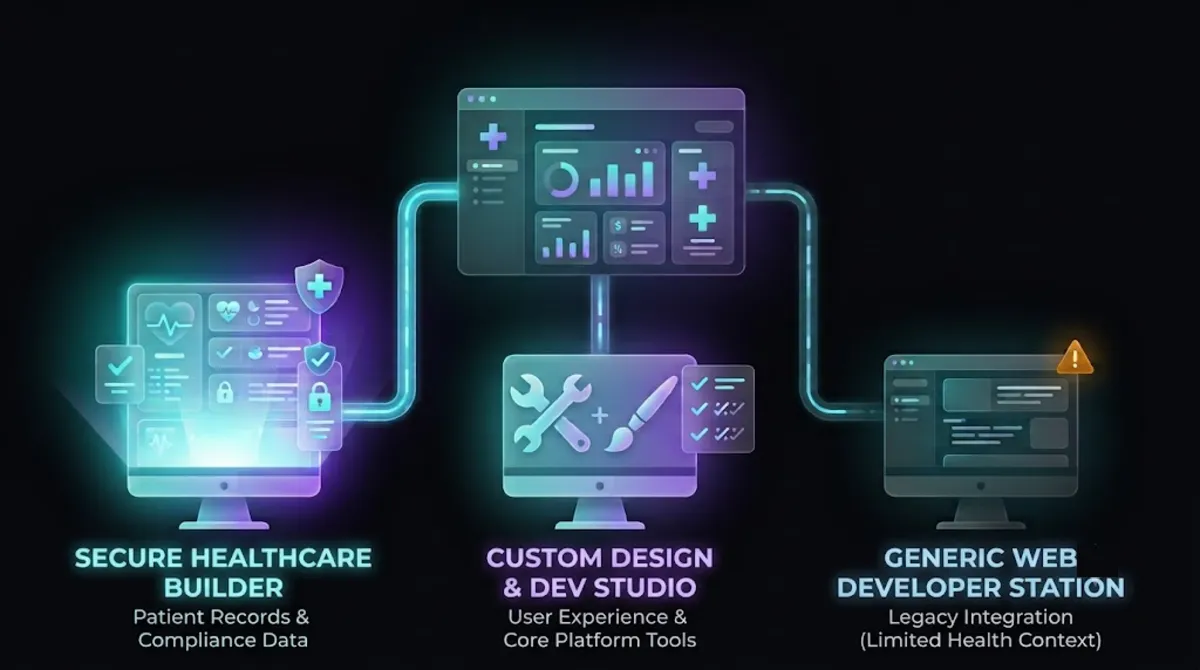
Your realistic options, and what each tends to deliver, look like this. A healthcare-specialist agency lives in this niche, knows HIPAA and what converts patients, and carries the least compliance risk, though it is often the most expensive. A capable studio with genuine healthcare experience can deliver the same compliance-aware, conversion-focused build, designing and developing it as one team so nothing is lost in handoff.
A general web developer may produce an attractive site but usually has no grasp of HIPAA, patient-data handling, or healthcare local SEO, which turns their strengths into your risk. The cheapest template-shop option is the riskiest of all, because a practice site built from a generic template tends to fail on exactly the compliance, trust, and booking points that matter most.
The pattern is that the more your website is a serious patient-acquisition channel, and for most practices it is a primary one, the more it pays to hire genuine healthcare capability rather than the lowest bid.
Hiring one team to design and build also avoids the gap where a good design gets watered down by a developer who does not understand the healthcare context. For the broader question of who to hire for any web build, our guide on hiring a WordPress developer covers the fundamentals.
Want a studio that understands healthcare?
We build compliant, patient-focused websites for medical and dental practices, designed and developed by one team. Tell us about your practice.
What a Good Practice Website Is Worth
A good dental or medical practice website is worth far more than it costs, because a single new patient often exceeds the entire cost of the site, and the website is most practices’ primary patient-acquisition channel. The return on getting it right is unusually high in healthcare.
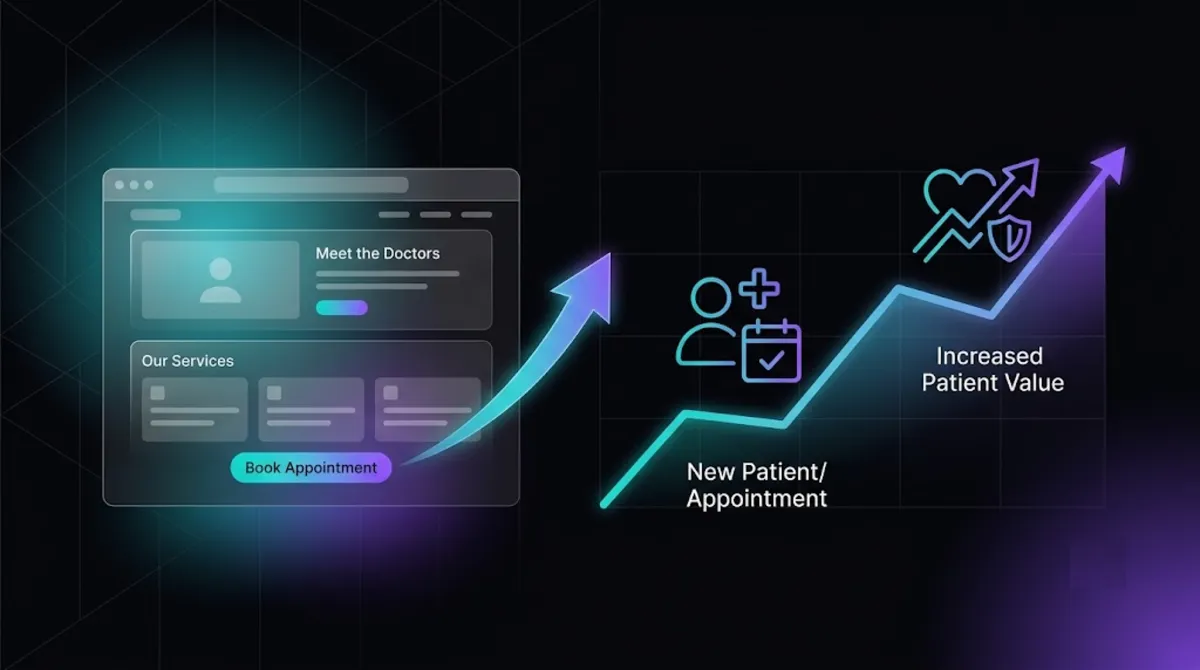
The economics are unusually favourable in healthcare. The large majority of patients research online before choosing a provider, so your website is where most decisions to book begin.
And because a new patient can be worth a great deal over their relationship with the practice, even a few extra patients won through a better site can pay for the entire build many times over. Set that against the fact that most practice sites convert only a small share of visitors, and the upside of a properly built, conversion-focused site becomes clear.
This is why cutting corners here is a false economy. You are not buying a nicer-looking page, you are buying a patient-acquisition asset that works around the clock in the most competitive corner of local search. If a better-built site brings in even a few extra patients a month, it has already justified itself many times over. You can see transparent numbers on our pricing page. That value framing also sets realistic expectations for what the build costs.
What a Practice Website Costs in 2026
A custom dental or medical practice website typically costs $3,000 to $15,000 in 2026, depending on practice size, number of services, integrations like booking and practice-management systems, and content needs. Specialist developers cost more because they deliver compliant, conversion-focused sites that generalists cannot.

Here is roughly what to expect in 2026:
- Smaller or solo practice: $3,000–$6,000 for a custom, compliant site with a handful of service pages, provider bios, and secure booking.
- Established multi-provider practice: $6,000–$15,000+, reflecting more services, deeper content, practice-management integrations, and location pages.
- Very cheap offers: the sub-$1,000 template jobs almost always skip HIPAA-aware handling, trust architecture, and local SEO, which is exactly where a practice site has to be strong.
The value case for paying properly is straightforward: a specialist delivers a compliant, trust-building, conversion-focused site that becomes a real patient-acquisition channel, while a bargain template job produces a brochure that looks acceptable and quietly loses patients, or worse, creates a compliance problem. You are paying for healthcare-aware craft and reduced risk, not just visuals. Because patient data demands protection, ongoing WordPress security is also worth budgeting for. Before you commit, these seven checks confirm you have the right developer.
Want a clear quote for your practice’s site?
Tell us your services and goals and we will scope a fixed-price, compliant build. Get a practice website quote.
7 Things to Look For Before You Hire
Before you hire a developer for a dental or medical practice website, look for these seven things. Because the healthcare-specific risks are invisible in a portfolio of pretty screenshots, these checks separate a genuine healthcare-capable developer from a generalist.
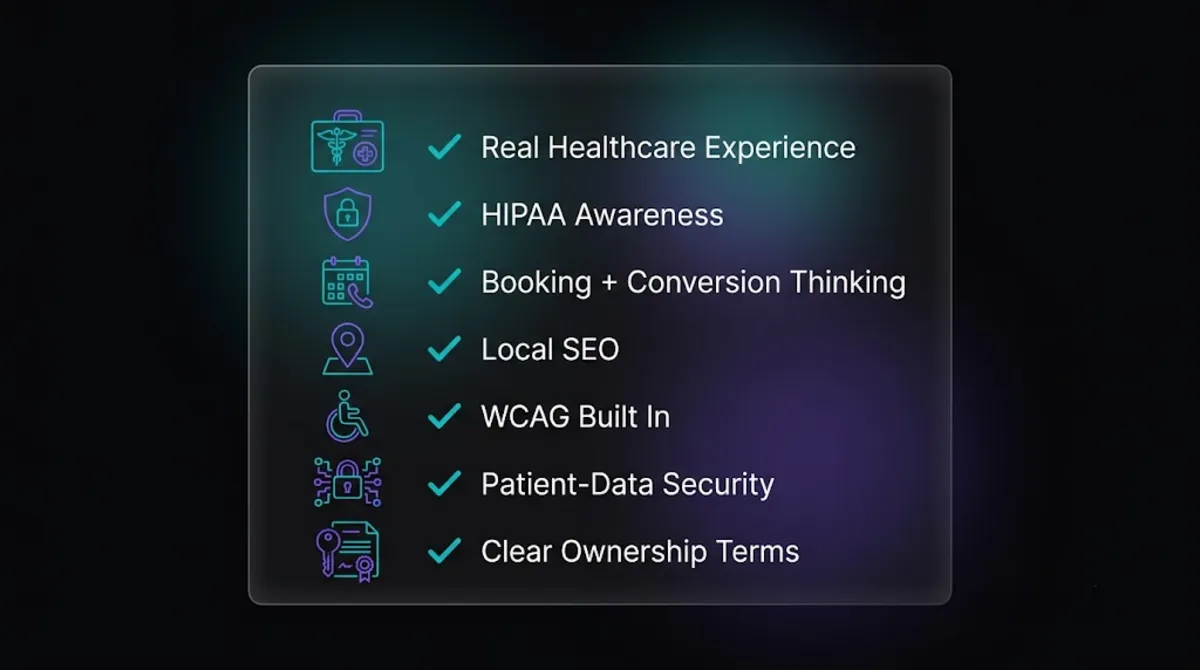
- Real healthcare experience. Actual medical or dental sites in their portfolio, not general business work with a clinic mentioned in passing.
- HIPAA awareness. They can talk about compliant forms, business associate agreements, and analytics safely, unprompted.
- Booking and conversion thinking. They discuss online scheduling, click-to-call, and trust signals, not just aesthetics.
- Local SEO capability. They understand per-service pages and local search, since that is how patients find you.
- Accessibility built in. They treat WCAG compliance as part of the build, not an afterthought or a plugin.
- Security for patient data. They have a clear answer for how patient information is protected end to end.
- Clear ownership terms. You own the domain, site, and content, with no hostage situation over access or hosting.
These checks work because genuine healthcare-web capability shows up in what a developer knows and asks about, not in how their screenshots look. A specialist raises HIPAA and booking before you do, because that is where their value lives. Someone who only wants to talk about visual style, and goes blank when you mention patient-data handling, is a generalist who will leave the risky parts to you.
Pro tip: Ask, “How do you handle patient data on the contact and booking forms?” A healthcare-capable developer has a real answer about compliant handling. A generalist will not know why it matters.
Use the quick tool below to see what kind of build fits your practice.
Ready for a practice website that brings in patients?
We build compliant, trust-first, conversion-focused sites for medical and dental practices. Tell us about your practice and we will take it from there. Start the conversation.
Frequently Asked Questions
Who is the best web developer for a dental or medical practice website?
The best choice is a healthcare specialist: a developer who understands HIPAA and patient-data handling, builds trust and secure online booking, and knows local SEO, rather than a generalist who treats a practice site like any other website. Often the safest option is a studio that both designs and builds and has real healthcare experience. Medical and dental sites are a core part of what we do, so if you want it built compliant and conversion-focused, we would be glad to help, and the same criteria apply to vetting anyone.
Why can’t a regular web developer build my practice website?
A talented generalist can build an attractive site, but most have no idea that patient data on forms, booking tools, and analytics carries HIPAA obligations, or how to handle it safely. Their oversight becomes your liability, because it is your practice that answers for a breach, not the developer. Healthcare-specific experience is what turns a nice-looking site into a compliant, effective one.
How much does a medical or dental practice website cost?
A custom practice website typically costs $3,000 to $6,000 for a solo or small practice and $6,000 to $15,000 or more for an established multi-provider practice, in 2026. The range reflects the number of services, depth of content, and integrations like booking and practice-management systems. Very cheap template jobs usually skip HIPAA-aware handling, trust architecture, and local SEO, which is exactly where a practice site has to be strong.
Does my practice website need to be HIPAA compliant?
It depends on what the site does. A purely informational site with only basic contact details has limited obligations, but the moment it collects identifiable patient information through intake forms, booking tools, chat, or certain analytics, HIPAA safeguards apply. Because it is easy to cross that line without realising, a healthcare-experienced developer builds the site so patient data is handled safely from the start. This is general information, not legal advice, so confirm your specifics with a compliance professional.
What makes a dental or medical practice website different?
Three things: federal privacy obligations around patient data, a heavy reliance on trust because patients are cautious and comparing providers, and the central role of secure online booking. On top of that, healthcare search is intensely local, and practice sites are treated as public accommodations for accessibility purposes. These requirements make it a specialist build rather than a generic one.
What platform is best for a practice website?
Many practices use WordPress, because it is flexible, well supported, and can be tailored to healthcare-specific needs like per-service pages, secure booking integrations, and strong local SEO, without being locked into a rigid template. A well-built custom WordPress site gives you clean code, good performance, and full ownership. The platform matters less than whether the developer understands healthcare requirements and builds properly.
Do I own my practice website after it is built?
You should, and this is worth confirming before you hire. A good developer gives you clear ownership of the domain, the site, the content, and full access, with no hostage situation over hosting or logins. Ask directly who owns each asset. If a provider is vague or keeps control of your domain or content, that is a warning sign regardless of how good the design looks.
Conclusion
When you need the best web developer for a dental or medical practice website, hire for healthcare capability, not just design skill. The right developer understands that a practice site handles patient data under federal privacy law, has to earn a cautious patient’s trust in seconds, depends on secure online booking, and lives or dies on local search, and they build all of that in from day one. The single biggest mistake is hiring a talented generalist who makes something attractive but has no idea the HIPAA obligations exist, because their oversight becomes your liability. Check for real healthcare experience, HIPAA awareness, booking and local-SEO thinking, and clear ownership terms, and you will quickly separate the healthcare-capable developers from the generalists. Get it right and your website becomes what it should be: the most reliable source of new patients your practice has.
Ready for a practice website done right?
We build compliant, trust-first, conversion-focused sites for medical and dental practices. Tell us about your practice and we will make it your best source of new patients. Get started today.
This article was last reviewed and updated in {{UPDATED}} to reflect current 2026 healthcare website standards, HIPAA considerations, and developer rates.