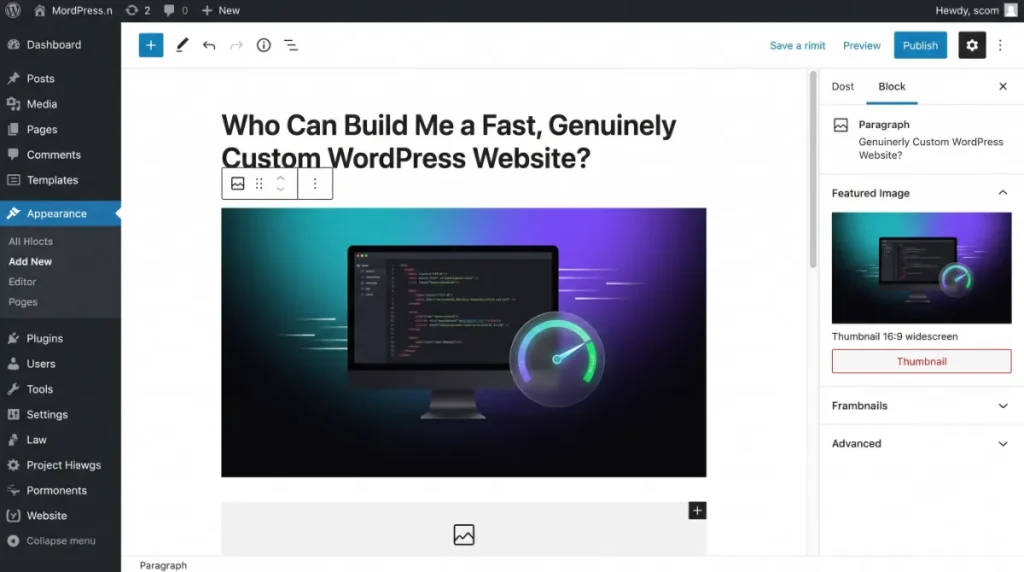
- A fast custom WordPress website is built from clean, hand-written code with no page-builder bloat, so nothing loads that your site does not need.
- “Genuinely custom” is not a fancy template. It means a purpose-built theme, not a drag-and-drop layout dressed up as custom work.
- Real custom builds are usually faster because they skip the nested code and unused scripts that slow page-builder sites down.
- Fast in 2026 means passing Google’s Core Web Vitals: an LCP under 2.5 seconds, INP under 200 milliseconds, and CLS under 0.1.
- To find the right developer, ask for live sites you can speed-test, and confirm they build without heavy page builders.
The person who can build you a fast custom WordPress website is a developer who writes clean, purpose-built code instead of assembling a heavy page-builder layout and calling it custom. That single distinction, real custom versus fake custom, decides whether your site loads in under two seconds or crawls, and it is the first thing to screen for when you hire.
If you have searched for someone to build a genuinely custom, fast WordPress site, you have probably noticed a problem: almost everyone claims to build “custom,” yet most deliver a bloated page-builder site that looks fine and loads slowly.
This guide cuts through that. It explains what a genuinely custom, fast custom WordPress website really requires, why clean code is the key to speed, and exactly how to find the rare developer who delivers both. Across 80+ builds over eight years, the difference has always come down to code, not marketing.
What “Genuinely Custom” Actually Means
Genuinely custom means your website is built from a purpose-made theme and hand-written code, with no drag-and-drop page builder generating the layout. Every line exists because your site needs it, not because a template shipped with it. That is the opposite of the “custom” most agencies sell, which is often a premium theme plus a page builder plus twenty plugins.
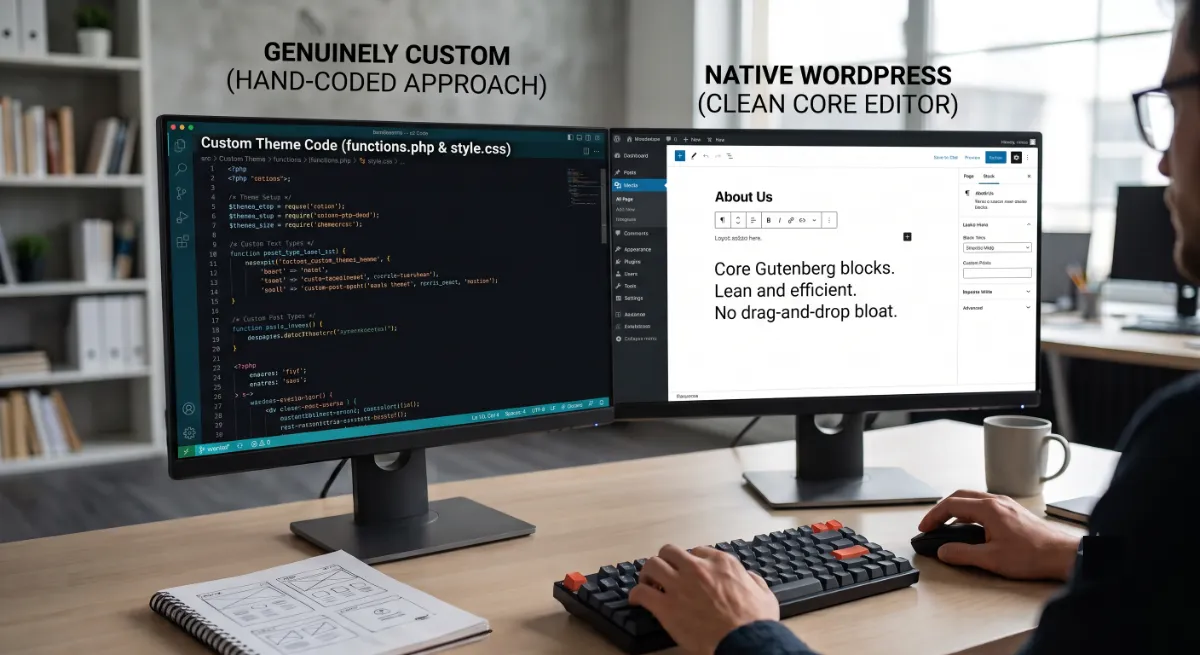
The distinction is not snobbery. It is structural. A page builder like Elementor or Divi gives you visual convenience by generating deeply nested HTML and loading scripts across your whole site, whether a page uses them or not. A genuinely custom theme skips all of that. As one performance-focused studio puts it, you do not reach top speed by bolting a caching plugin onto a bloated theme; you reach it by never shipping the bloat in the first place.
Here is how to tell the two apart at a glance:
- Genuinely custom: a bespoke theme, clean semantic HTML, only the code each page actually uses, no page-builder dependency.
- Fake-custom: a stock or premium theme, a page builder generating the layout, a stack of plugins patching the gaps, sold at custom prices.
A fake-custom site and a fast custom WordPress website can look identical on launch day. The difference shows up three months later, in your load times, your Core Web Vitals, and the invoice when something needs changing.
Pro tip: Ask any candidate directly, “Do you build with a page builder, or do you hand-code the theme?” The answer instantly sorts genuinely custom developers from the rest.
That structural difference is exactly why one approach is fast and the other rarely is.
Why a Fast Custom WordPress Website Beats Page Builders
A genuinely custom site is usually faster because it loads only the code the page needs, while page builders ship large amounts of CSS and JavaScript that visitors download but never use. Less code means less for the browser to process, which means a quicker load. A fast custom WordPress website is designed for speed from the start, not tuned for it later.
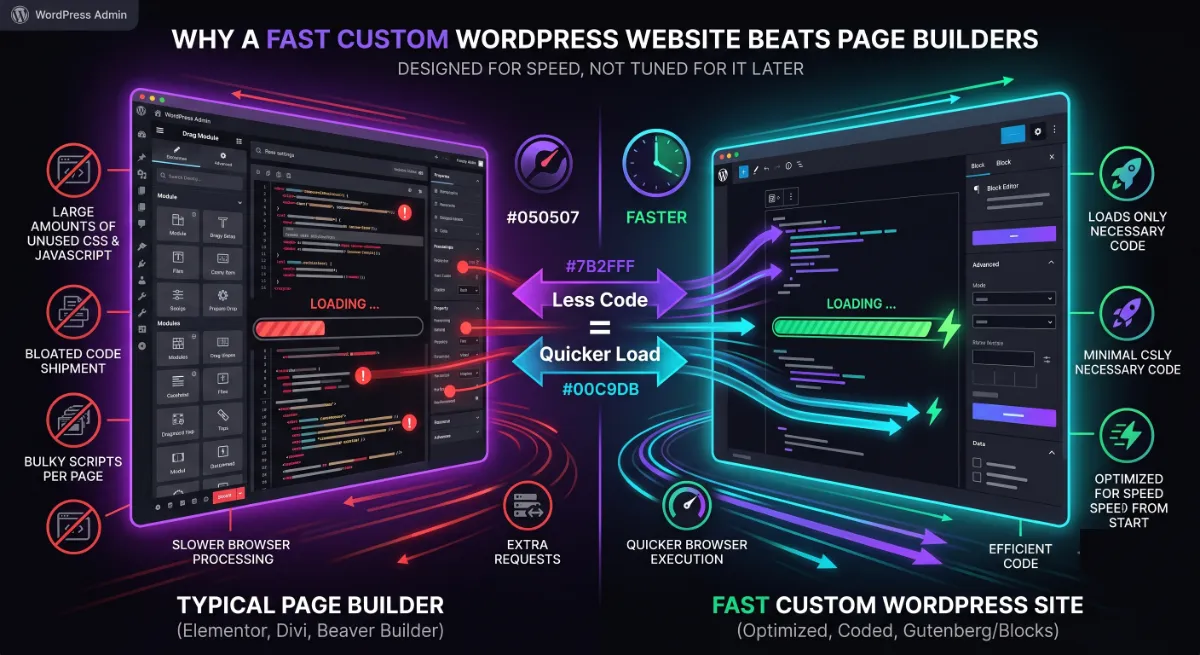
The mechanism is concrete. Consider a simple hero section with a heading, an image, and a button. A lean custom build might render that in a handful of HTML elements. A page builder can generate the same visual result with dozens of nested containers, plus CSS and JavaScript files loaded site-wide. Every one of those extra elements and files gives the browser more work to do before your visitor sees anything.
This is not a small concern. Google now judges every site on real-world speed, and slow pages are penalised in both rankings and conversions. In fact, industry research suggests a single one-second delay in load time can reduce conversions by roughly 7%. Furthermore, only about 53% of websites currently pass all three of Google’s Core Web Vitals, which means speed is a genuine competitive edge, not a given.
To hire for speed, though, you need to know what “fast” actually means in measurable terms.
What “Fast” Actually Means in 2026
In 2026, fast means passing Google’s Core Web Vitals: a Largest Contentful Paint under 2.5 seconds, an Interaction to Next Paint under 200 milliseconds, and a Cumulative Layout Shift under 0.1. These are the numbers behind a fast custom WordPress website, and the ones you can hold a developer accountable to.
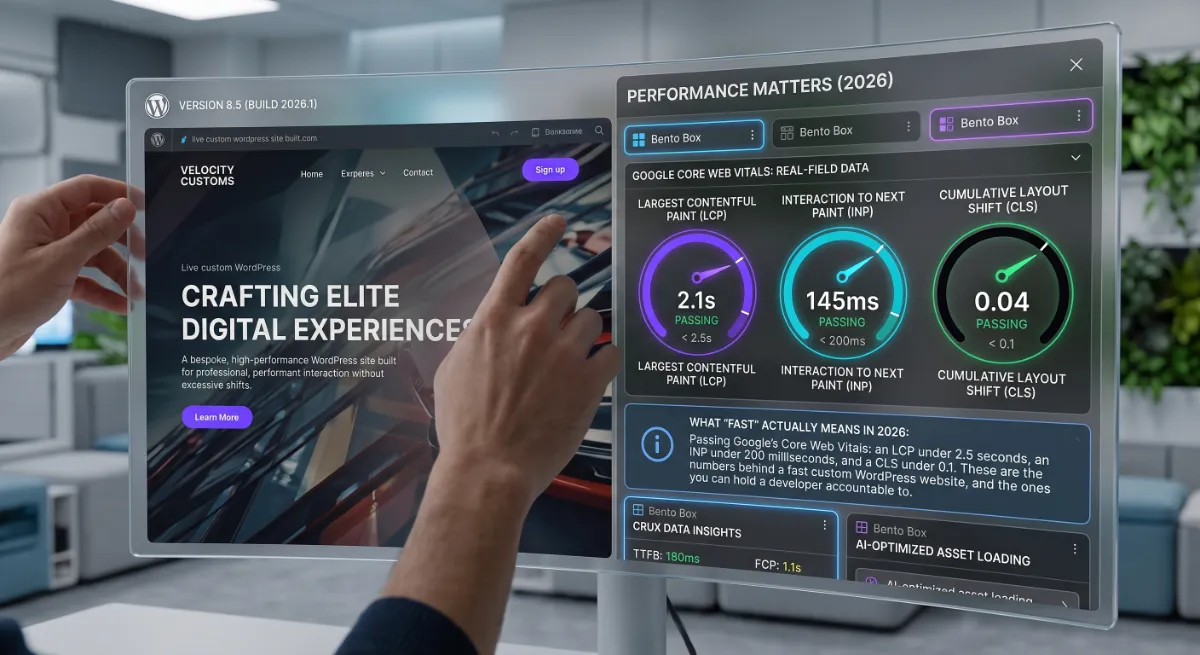
According to Google’s official Core Web Vitals guidance, these three metrics measure real-world loading, responsiveness, and visual stability, and Google recommends every site owner aim to pass them. They are measured on real visitors, not on a developer’s fast laptop, so a site that feels quick in a demo can still fail in the field.
Here is what each number means in plain terms:
- LCP (loading): under 2.5 seconds for your main content to appear. This is the one people feel most, and Google’s web.dev guidance on LCP treats 2.5 seconds as the line between good and mediocre.
- INP (responsiveness): under 200 milliseconds for the page to react when someone taps or clicks.
- CLS (stability): under 0.1, so the layout does not jump around as it loads.
Speed expectations have only tightened. Elementor’s own research notes that 47% of users now expect a page to load in under two seconds. Consequently, “fast enough” is no longer a matter of opinion. It is a set of numbers you can test on any URL a developer shows you, which makes vetting refreshingly objective.
Pro tip: Run any portfolio URL through Google’s free PageSpeed Insights. If a developer’s own showcased work fails Core Web Vitals on mobile, that tells you what your site will look like too.
With a clear definition of both custom and fast, the real question becomes who can actually deliver them together.
Who Can Build a Fast Custom WordPress Website
The developer who can build a fast custom WordPress website is usually a senior independent developer or a small specialist studio that hand-codes themes, rather than a volume agency running everything through a page builder. Building a fast custom WordPress website is a specific skill set, and not every “WordPress developer” has it.

The market splits into rough groups. Budget freelancers often lean on templates and page builders to work quickly, which rarely produces genuine speed. Volume agencies frequently standardise on a page builder so their team can produce sites at scale, trading performance for throughput. The developers who reliably deliver fast custom work tend to be senior independents and small studios who treat clean code and Core Web Vitals as the point, not an afterthought.
This is closely related to choosing any developer, so it is worth reading our broader guide on who to hire to build a custom WordPress website alongside this one. The difference here is the specific emphasis on speed and genuinely hand-coded work, which our own custom WordPress development is built around. And if your existing site is simply slow, a focused website speed optimization can fix the symptom without a full rebuild.
Curious whether your current site could be faster?
We will run it through Core Web Vitals and tell you honestly whether it needs a rebuild or just a tune-up. Ask for a free speed read.
Knowing the type of developer is a start. Confirming a specific candidate is the real work, and it comes down to seven checks.
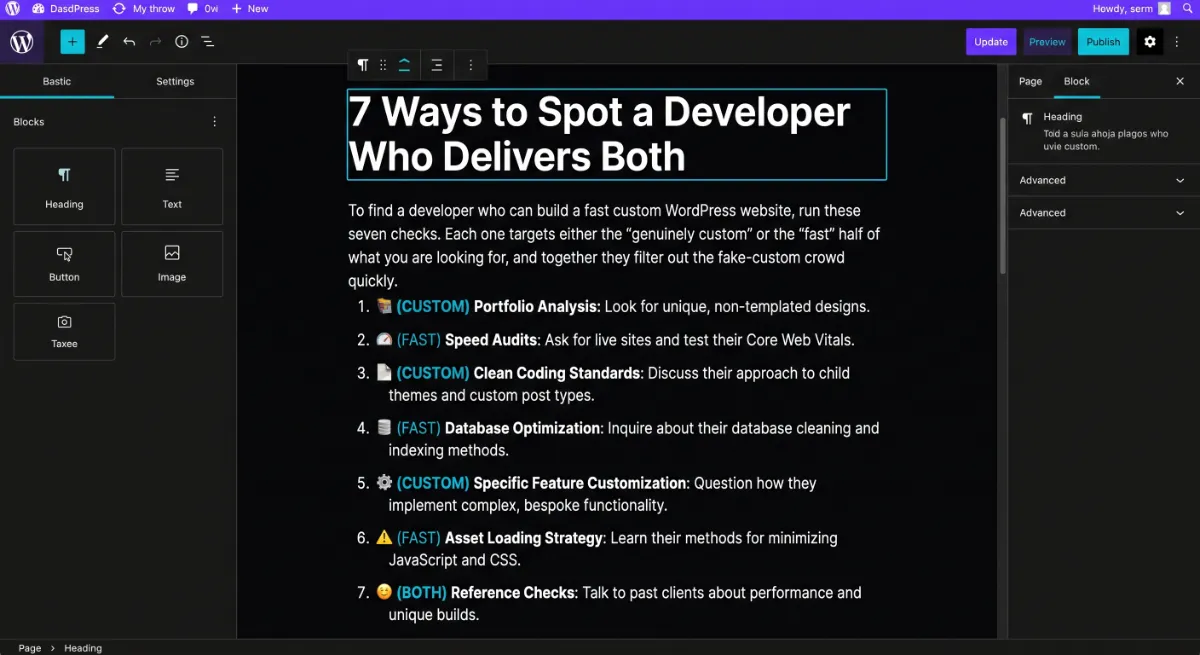
7 Ways to Spot a Developer Who Delivers Both
To find a developer who can build a fast custom WordPress website, run these seven checks. Each one targets either the “genuinely custom” or the “fast” half of what you are looking for, and together they filter out the fake-custom crowd quickly.
- Speed-test their live work. Run their portfolio URLs through PageSpeed Insights. Passing Core Web Vitals on mobile is the proof that matters.
- Ask how they build the theme. Hand-coded or a page builder? The honest answer sorts genuine from fake-custom instantly.
- Check the plugin count. A lean custom site needs few plugins. A twenty-plugin proposal signals bloat, not craft.
- Ask about Core Web Vitals directly. A speed-focused developer talks in LCP, INP, and CLS without prompting.
- Request a performance commitment. Will they commit, in writing, to passing Core Web Vitals at launch? Serious developers will.
- Look at their code ownership terms. Genuinely custom work means you get clean code you own, not a locked page-builder license.
- Confirm mobile-first testing. Most traffic is mobile, and Core Web Vitals are judged there. Ask how they test it.
These checks work because they are objective. You are not taking anyone’s word for “fast” or “custom.” You are testing live URLs and asking questions only a genuine custom developer can answer comfortably.
Pro tip: The single most revealing question is, “Can I see the PageSpeed score of a site you built?” A confident yes, with a real URL, is worth more than any sales pitch.
Just as useful as knowing what to look for is knowing the warning signs that scream fake-custom.
Red Flags That Signal Fake-Custom
The clearest red flag is a developer who calls their work custom but builds everything on a page builder and cannot show you a fast, passing Core Web Vitals score. A few specific signals reliably reveal a fake-custom build sold at custom prices.
Watch for these in particular:
- They dodge the page-builder question, or treat “custom” and “built in Elementor” as the same thing. They are not.
- Their own portfolio sites are slow. If their showcased work fails a speed test, yours will too.
- They propose a long plugin list to achieve basic functions a custom theme would handle in code.
- They cannot talk about Core Web Vitals beyond vague promises that the site will be “fast” and “optimised.”
- They will not commit to performance in writing, or get defensive when you ask them to.
None of these red flags require you to be technical. They simply require you to test the live work and listen for a straight answer. With the warning signs clear, the last practical question is cost.
What a Fast Custom WordPress Website Costs
A fast custom WordPress website typically costs $3,000 to $8,000 in 2026 for a genuinely bespoke build, more than a template-and-page-builder site, because hand-coded work takes real skill and time. That premium on a fast custom WordPress website usually pays for itself in speed, SEO, and far lower maintenance costs later.
The gap in upfront price is real but often misunderstood. A page-builder site can be cheaper to start, yet it tends to cost more over time through premium plugin licences, compatibility breaks, and the slow performance that quietly costs you rankings and conversions. A genuinely custom build front-loads the investment and avoids most of that recurring drag. You can see our own transparent numbers on the pricing page, no sales call required.
Want a fixed quote for a genuinely fast, custom build?
Tell us what you need. You will get a clear price and a performance commitment, not a vague estimate. Get a fixed quote.
Cost only makes sense once you know you are paying for the real thing. Use the quick checker below to see whether you actually need a fast custom build, or something lighter.
Frequently Asked Questions
Who can build me a fast, genuinely custom WordPress website?
A senior independent developer or a small specialist studio that hand-codes themes is your best bet, rather than a volume agency running everything through a page builder. Ask for live portfolio sites, run them through PageSpeed Insights, and confirm the developer will commit to passing Core Web Vitals at launch.
What is the difference between genuinely custom and a page-builder site?
A genuinely custom site uses a hand-coded, purpose-built theme where every line of code serves a purpose. A page-builder site uses drag-and-drop tools like Elementor that generate heavy, nested code loaded site-wide. Both can look similar, but the custom build is typically much faster and cleaner underneath.
Why is a custom WordPress site faster than a page-builder one?
A custom site loads only the code each page actually needs, while page builders ship large amounts of CSS and JavaScript that visitors download but never use. Less code means less work for the browser, so the page appears faster. Speed is designed in from the start rather than patched on later.
How do I know if a WordPress developer builds fast sites?
Run their live portfolio URLs through Google PageSpeed Insights and check whether they pass Core Web Vitals on mobile. Ask directly whether they hand-code themes or use a page builder, and whether they will commit in writing to passing Core Web Vitals at launch. Real speed shows up in the numbers.
What does fast mean for a website in 2026?
Fast means passing Google’s Core Web Vitals: Largest Contentful Paint under 2.5 seconds, Interaction to Next Paint under 200 milliseconds, and Cumulative Layout Shift under 0.1. These are measured on real visitors on real devices, so a site must perform well in the field, not just in a demo.
How much does a fast custom WordPress website cost?
A genuinely custom, fast WordPress build typically costs $3,000 to $8,000 in 2026, more than a template-and-page-builder site. The higher upfront price usually pays off through better speed, stronger SEO, and lower long-term maintenance, since you avoid premium plugin fees and the performance drag of a bloated build.
Can I make my existing WordPress site faster without a rebuild?
Sometimes. If your site is fundamentally sound but slowed by unoptimised images, caching, or a few heavy plugins, a focused speed optimization can help without a full rebuild. If the slowness comes from deep page-builder bloat, a genuinely custom rebuild is usually the more cost-effective long-term fix.
Conclusion
When you want someone to build a fast custom WordPress website, the real skill you are hiring for is restraint: a developer who hand-codes a lean theme and refuses to ship bloat. Screen for it by testing live sites against Core Web Vitals, asking whether they build with a page builder, and requiring a performance commitment in writing.
Do that, and you filter out the fake-custom crowd fast. You end up with a site that is genuinely custom, genuinely fast, and cheaper to own over its lifetime. The proof is always in a live URL you can test yourself.
Ready for a site that is genuinely custom and genuinely fast?
Bring us your project or your slow current site. We will give you a fixed quote and a Core Web Vitals commitment, in writing. Start the conversation.
This article was last reviewed and updated in {{UPDATED}} to reflect current 2026 Core Web Vitals thresholds and custom WordPress development practices.