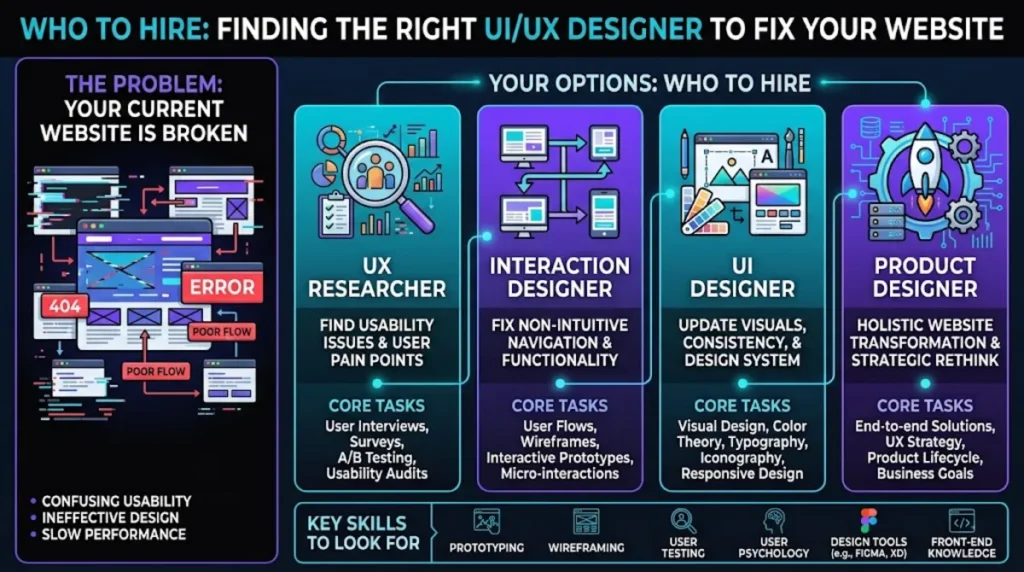
- When you need a UI/UX designer to fix your website, hire someone who diagnoses why visitors do not convert, not just someone who makes it look prettier.
- A real UI/UX designer works on flow, hierarchy, friction, and trust, and can show case studies with measured outcomes, not only attractive screenshots.
- The clearest red flag is a portfolio full of beautiful visuals with no evidence of research, process, or results.
- A UI/UX designer typically costs $1,000 to $5,000 for a website project in 2026, depending on scope and whether they also build it.
- Vet for a real process, case studies tied to conversions, and the ability to explain the reasoning behind every design decision.
When you need a UI/UX designer to fix your website, hire someone who diagnoses why the site is not working, the flow, friction, hierarchy, and trust, and who can show case studies with real outcomes, not just attractive mockups. Avoid a designer whose portfolio is all pretty visuals and no evidence of results, because looking nicer is not the same as working better.
Here is the frustrating part: your site is not obviously broken. It loads, it looks fine, but visitors land and leave, and you cannot quite say why. That vague “something is off” feeling is almost always a UX problem, and it is exactly what the right UI/UX designer is trained to find and fix. This guide explains what a real UI/UX designer does, how to tell genuine design from mere decoration, who to hire, and what it costs in 2026.
“It Works but Doesn’t Convert”: What’s Really Wrong
When a website works but does not convert, the problem is usually the user experience, not the visuals, so you need a designer who diagnoses friction rather than one who simply restyles the page. The cause is often invisible until someone trained looks for it.
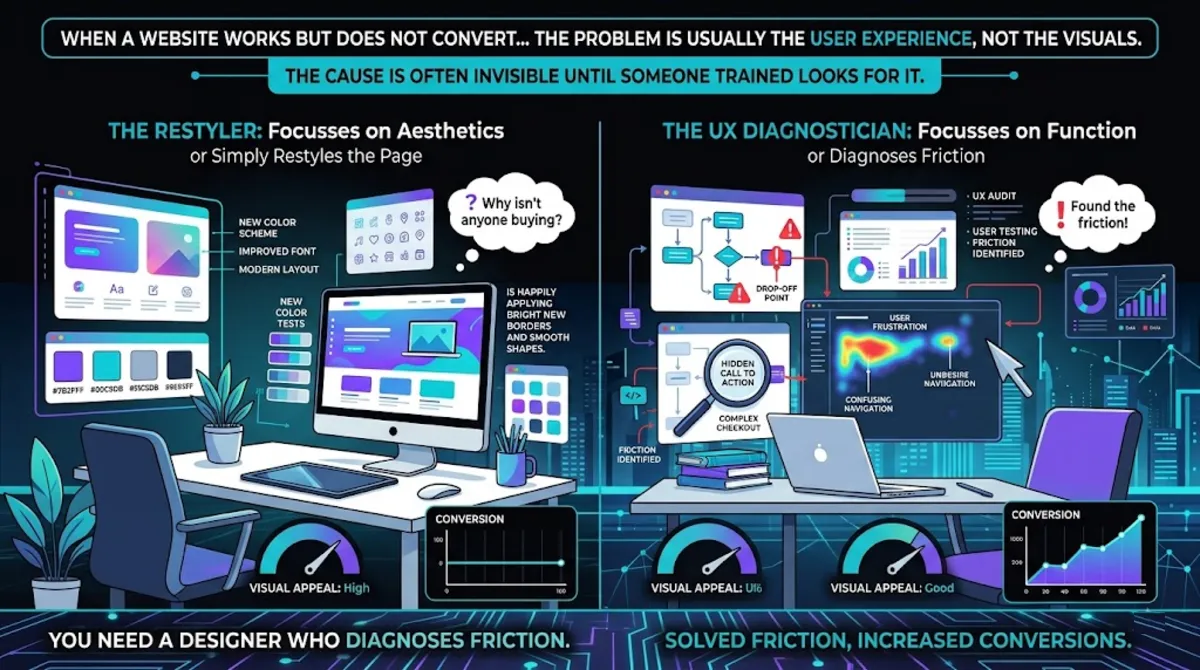
The reason you cannot name the problem is that UX failures are quiet. Nothing errors out; visitors just quietly give up. The usual culprits are things a casual look never catches:
- Unclear hierarchy. Nothing guides the eye, so visitors do not know where to look or what matters most.
- Hidden or weak calls to action. The one thing you want people to do is buried, vague, or competing with five other links.
- Friction in the flow. Too many steps, confusing navigation, or a form that asks for too much, and people abandon partway; Baymard’s checkout research finds flow is frequently the sole reason people give up.
- Weak trust signals. Nothing reassures a first-time visitor quickly enough, and hesitation becomes a bounce.
This matters because first impressions form fast and are overwhelmingly about design. Research finds that visitors form an opinion of a site in a few seconds and that around 94% of first impressions are design-related, while a large majority of people will not return after a bad user experience.
None of that shows up in a quick glance at your own site, which is why the fix needs a trained eye rather than a fresh coat of paint. That trained eye is a designer, and it helps to know exactly what one does.
Pro tip: Before hiring, note where you think visitors drop off. A good UI/UX designer will confirm or overturn that hunch with evidence, not just agree with you and restyle the page.
What a UI/UX Designer Actually Does
A UI/UX designer researches how people use your site, maps the flows that lead to your goal, removes friction, and designs an interface that guides visitors to act. UX is how the site works; UI is how it looks; a real designer handles both together.
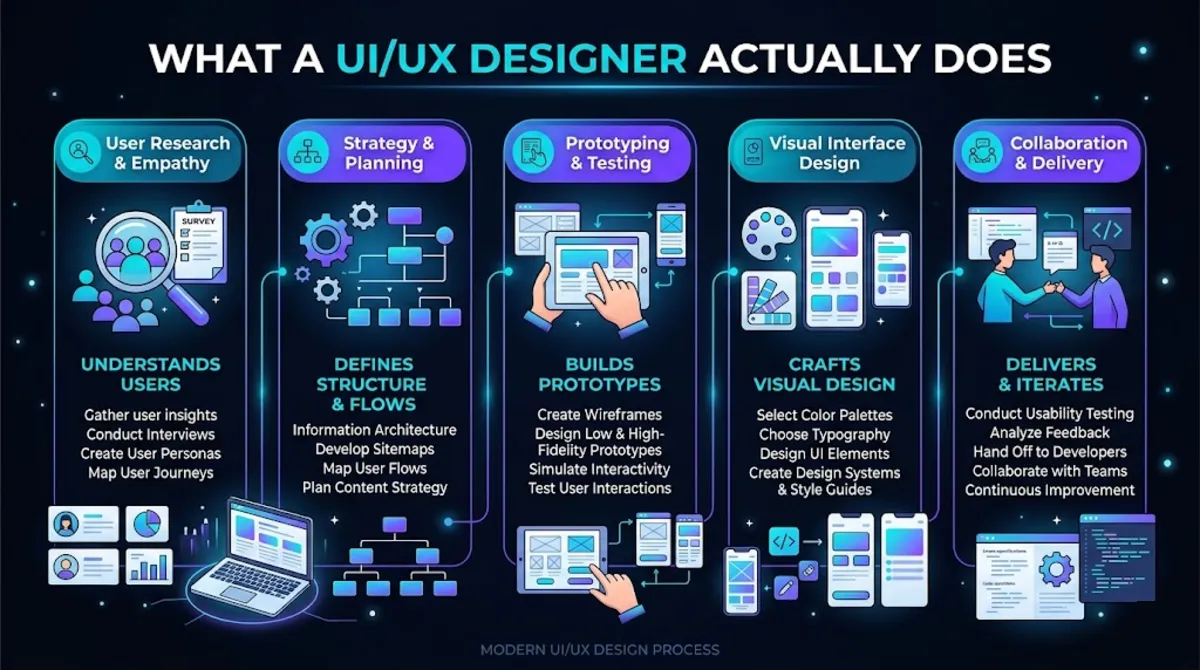
It helps to separate the two halves of the job, because buyers often conflate them:
- UX (user experience) is how it works. The structure, the flow, how easily someone reaches their goal. This is the research, user journeys, wireframes, and friction removal, the part that actually decides whether people convert.
- UI (user interface) is how it looks. The visual design, typography, colour, spacing, and components. It carries the experience and builds trust, but it sits on top of the UX, not instead of it.
A genuine designer does the unglamorous work first: understanding your users and goals, mapping the journey, identifying where people hesitate, and only then designing the interface. They often validate their thinking with real users, and here the research is clear: testing with just five users uncovers the large majority of usability problems, so a designer who does even lightweight testing catches issues before they cost you conversions. You can see how we approach this on our UI/UX design service.
Want your site fixed at the experience level, not just restyled?
We design around how people actually use your site, and tie every decision to your goals. See our UI/UX design.
That “research and flow first, visuals second” order is exactly what separates a real designer from someone who only decorates.
Design vs Decoration: The Difference That Matters
The difference between a real designer and a decorator is that one solves a business problem, better conversions and clearer flow, while a decorator only makes things look nicer. A prettier site that still does not convert has fixed nothing.
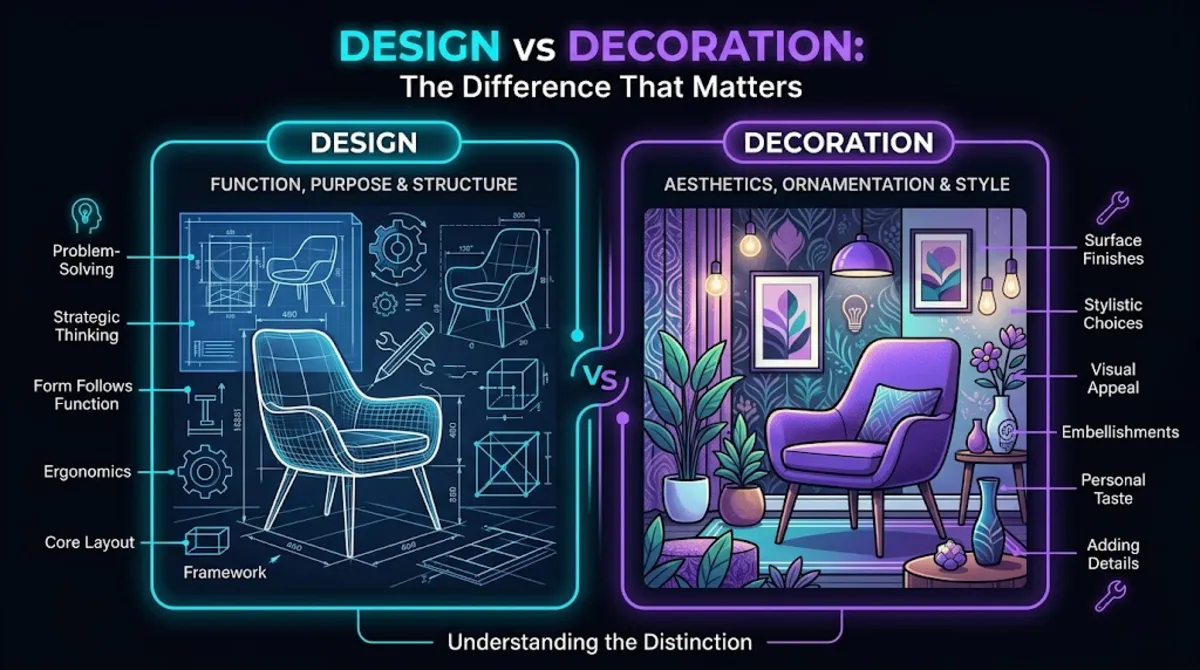
This is the single most important distinction when you hire, because a lot of people who call themselves designers are really decorators. A decorator restyles what is already there: new colours, a trendier font, a fresh hero image. It looks better, and nothing about the underlying experience changes, so the conversion problem you hired them to fix is still there under the new paint.
A real designer starts from the problem. Why are people leaving? Where is the friction? What is the one action this page should drive? Then they redesign the experience around the answer, and the visuals serve that purpose rather than being the whole point. The tell is simple: a decorator talks almost entirely about how things look, while a designer talks about what the design is trying to achieve and how they will know it worked.
Pro tip: Ask a candidate, “How would you decide what to change on my site?” A designer describes research and diagnosis. A decorator jumps straight to visual style choices.
Understanding that difference makes the next decision, who exactly to hire, much clearer.
Who to Hire: Designer, Developer, or Both
To fix a website’s experience, you can hire a UI/UX designer, a designer who also builds, or a developer with design sense, and the right choice depends on whether your problem is the design, the build, or both. Matching the hire to the real problem saves time and money.
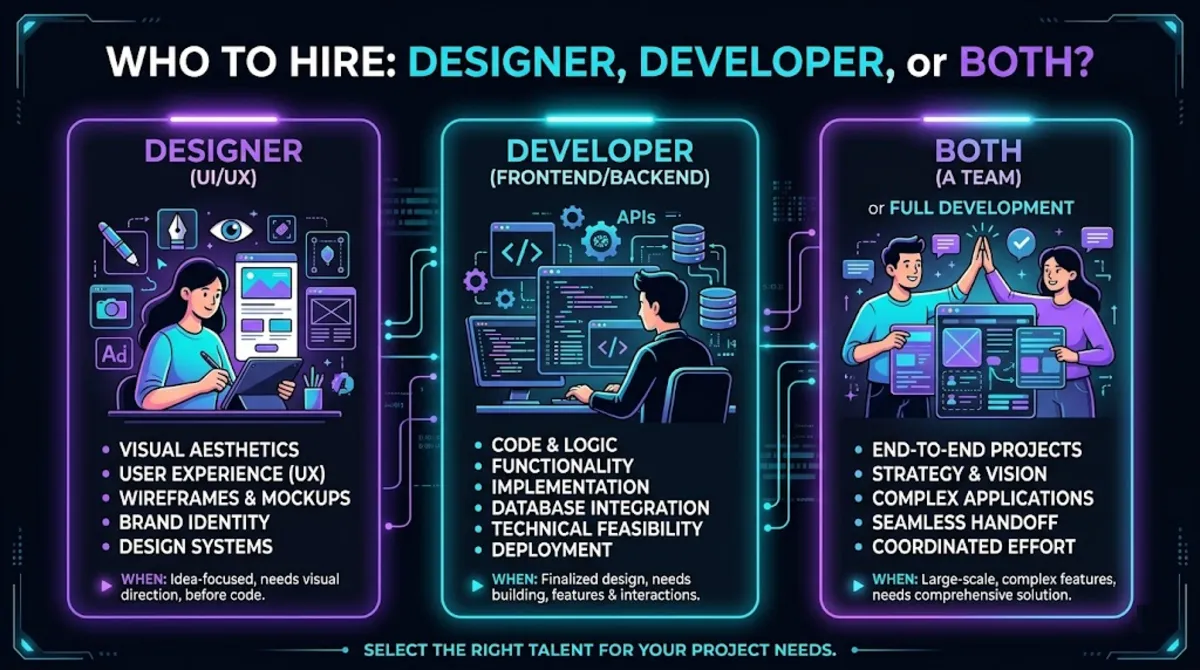
Your realistic options, and when each fits, look like this. A dedicated UI/UX designer is right when the problem is clearly the experience and you have a developer who can build their designs; they go deepest on research and flow. A designer who also builds, common at studios, is ideal when you want the fix designed and implemented by one team, so nothing is lost handing designs to a separate developer.
A developer with genuine design sense can work for smaller fixes, though most developers are not trained UX designers and it shows on complex problems. A pure visual designer or decorator is the wrong hire when the issue is conversion, because that is a UX problem, not a styling one.
The pattern is that the more your problem is about why people do not convert, the more you want genuine UX skill in the mix, not just visual polish.
If the fix also needs building, hiring one team to design and implement avoids the gap where good designs get watered down in development. For the broader question of who to hire for any web work, our guide on hiring a WordPress developer covers the fundamentals, and if your site also needs a full rebuild, our website redesign service pairs design with the build.
Not sure if you need design, build, or both?
Tell us what your site is doing (or not doing) and we will tell you honestly what will actually fix it. Ask us.
Whichever route fits, it helps to see what a genuine UI/UX designer is actually worth.
What a Good UI/UX Designer Is Worth
A good UI/UX designer is worth far more than they cost, because better UX directly lifts conversions, trust, and revenue. The measured return on user experience is one of the highest in all of digital, which is what makes this hire an investment rather than an expense.

The figures make the case on their own. A widely cited Forrester finding puts the return on user experience investment as high as $100 for every $1 spent, and other research links strong interface design to conversion increases of up to 200%.
On the flip side, a large share of online businesses fail on usability rather than product, and most people simply will not come back after a bad experience. The McKinsey Design Index likewise found that design-led companies grow revenue meaningfully faster than their peers. In other words, poor UX is quietly expensive, and fixing it is one of the most reliable ways to get more from the traffic you already have.
Set against those numbers, the cost of a good UI/UX designer is small. If fixing the experience lifts your conversion rate even modestly, it pays for itself many times over, before counting the trust and brand benefits that are harder to measure but very real. That is the true case for hiring quality: you are not buying a prettier site, you are buying more of the customers your site already attracts. You can see transparent numbers on our pricing page.
With the value clear, here is what a UI/UX designer typically costs.
What a UI/UX Designer Costs in 2026
A UI/UX designer typically costs $1,000 to $5,000 for a website project in 2026, or roughly $75 to $150 an hour, depending on scope, seniority, and whether they also build the site. Specialists cost more because they deliver measured results, not just visuals.

Here is roughly what to expect in 2026:
- Focused fix: $1,000–$2,000 for redesigning a key page or flow, such as a homepage or checkout, where the conversion problem concentrates.
- Full site design: $2,500–$5,000+ for redesigning the whole experience, scaling with page count and complexity.
- Hourly: $75–$150 for a skilled designer, with senior or specialist designers higher.
- Very cheap offers: the $50–$100 gig listings are usually decoration, a restyle with no research, flow work, or measured outcome.
The value case for paying properly is straightforward: a real UI/UX designer diagnoses and fixes the experience so more visitors convert, while a bargain decorator restyles the surface and leaves the underlying problem untouched. You are paying for a measurable outcome, not a nicer screenshot. If your site also needs conversion-focused single pages for campaigns, that overlaps with landing page design, which follows the same design-for-outcomes logic.
Want a clear quote to fix your site’s experience?
Tell us what is not working and we will scope it with a fixed price and a plan tied to your goals. Get a design quote.
Before you commit to anyone, these seven checks confirm you have found a real designer.
7 Things to Look For Before You Hire
Before you hire a UI/UX designer, look for these seven things. Because design quality lives in reasoning and results a client cannot see in a screenshot, these checks separate a genuine designer from a decorator.
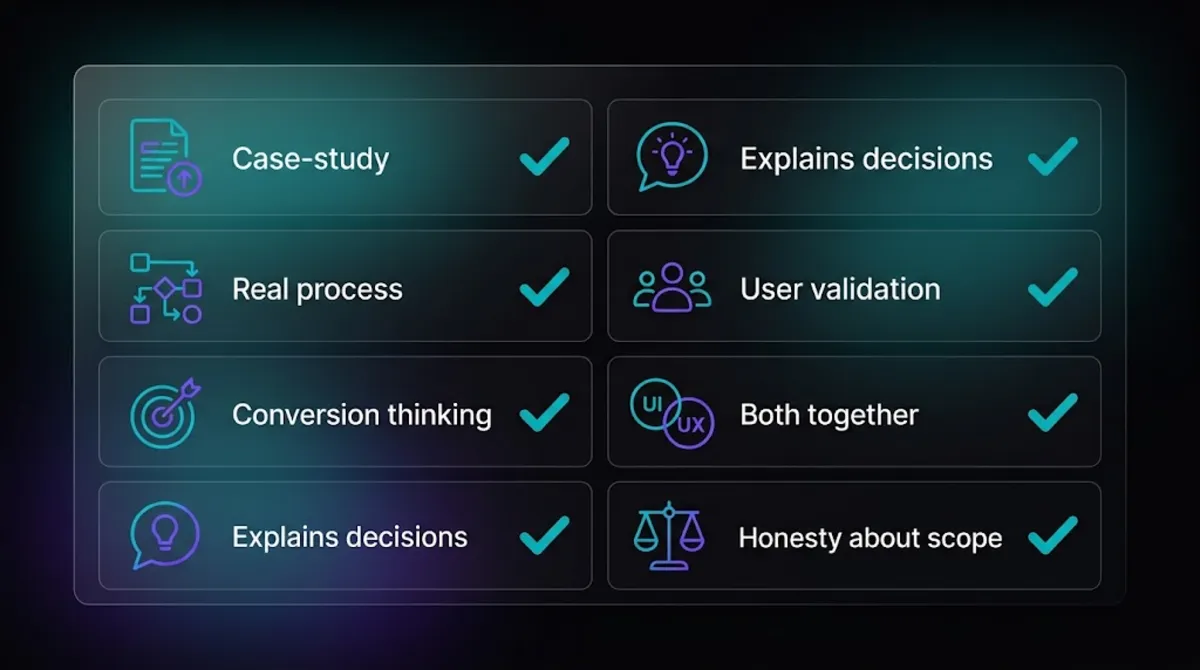
- Case studies with outcomes. Portfolio pieces that show the problem, the process, and a measured result, not just pretty final screens.
- A real process. They research, map flows, and diagnose before designing, rather than jumping straight to visuals.
- Conversion thinking. They talk about goals, friction, and results, not only aesthetics.
- The ability to explain decisions. They can tell you why each choice was made, which proves it was intentional.
- Some user validation. Even lightweight testing, since a handful of users surfaces most usability problems.
- UX and UI together. They understand both how a site works and how it looks, and how the two reinforce each other.
- Honesty about scope. They tell you whether you need a full redesign or a focused fix, rather than upselling reflexively.
These checks work because genuine design shows up in reasoning and results, not appearances. A specialist welcomes questions about their process and their outcomes, because that is where their advantage lives. Someone who only wants to show you beautiful final screens, and gets vague when you ask why, may be a decorator in a designer’s clothing.
Pro tip: Ask to see one case study end to end: the problem, what they changed, and what happened after. A real designer has at least one. A decorator only has a gallery.
Use the quick tool below to see what kind of design help fits your site.
Ready for a site that actually converts?
We fix the experience, not just the look, and tie every decision to your goals. Tell us about your site and we will take it from there. Start the conversation.
Frequently Asked Questions
I need a UI/UX designer to fix my website, who do you recommend?
Hire a UI/UX designer who diagnoses why your site is not working, the flow, friction, hierarchy, and trust, and who can show case studies with measured outcomes rather than only attractive screenshots. Avoid anyone whose portfolio is all pretty visuals and no evidence of process or results. UI/UX design is a core part of what we do, so if you want the experience fixed properly, we would be glad to help, and the same criteria apply to vetting anyone.
What is the difference between UI and UX design?
UX (user experience) is how a site works: the structure, the flow, and how easily someone reaches their goal. UI (user interface) is how it looks: the visual design, typography, colour, and layout. A good UI/UX designer handles both together, because a beautiful interface on top of a confusing experience still fails, and a great experience with weak visuals fails to build trust. The two reinforce each other.
How much does a UI/UX designer cost?
A UI/UX designer typically costs $1,000 to $2,000 for a focused fix like a single key page, and $2,500 to $5,000 or more for a full site design, in 2026. Hourly rates are usually $75 to $150 for a skilled designer. Very cheap offers, the $50 to $100 gig listings, are usually decoration, a restyle with no research or measured outcome. A specialist costs more because they deliver real results.
My website looks fine but doesn’t convert. Is that a UX problem?
Almost always, yes. When a site looks fine but visitors leave without acting, the issue is usually the experience: unclear hierarchy, hidden calls to action, friction in the flow, or weak trust signals. These are invisible at a glance, which is exactly why a UI/UX designer, trained to find and fix them, is the right hire rather than someone who just makes it look different.
Can a developer fix my UX, or do I need a designer?
Some developers have genuine design sense and can handle smaller fixes, but most are not trained UX designers, and it shows on complex conversion problems. If your issue is clearly about why people do not convert, you want real UX skill in the mix. Often the best option is a team that both designs and builds, so the design is created and implemented without anything being lost in handoff.
How do I tell a real UI/UX designer from someone who just makes things pretty?
Look at how they talk and what they show. A real designer describes research, diagnosis, and outcomes, and can explain the reasoning behind every decision. A decorator talks almost entirely about visual style and shows a gallery of pretty final screens with no process or results. Ask how they would decide what to change on your site: a designer describes a diagnostic approach, a decorator jumps straight to aesthetics.
Should I redesign the whole site or just fix part of it?
It depends on where the problem is. If one page or flow is underperforming, a focused fix is often enough and far cheaper. If the whole experience is dated or confusing, a full redesign makes sense. A good UI/UX designer will tell you honestly which you need rather than upselling a full rebuild by default, so ask for that assessment early.
Conclusion
When you need a UI/UX designer to fix your website, hire someone who treats it as a problem to diagnose, not a surface to repaint. A real designer investigates why visitors are not converting, the flow, the friction, the hierarchy, the trust, and redesigns the experience around the answer, with the visuals serving that purpose rather than being the whole point.
The single biggest mistake is hiring a decorator: someone who makes the site look nicer while the conversion problem sits untouched underneath. Check for case studies with real outcomes, a genuine process, and the ability to explain every decision, and you will quickly separate the designers from the decorators. Get it right and good UX becomes one of the highest-return investments you can make, turning more of the visitors you already have into customers.
Ready to fix your site’s experience properly?
UI/UX design is a core part of what we do. Tell us what is not working and we will make your site genuinely convert, not just look better. Get started today.
This article was last reviewed and updated in {{UPDATED}} to reflect current 2026 UI/UX design practices, conversion research, and designer rates.